A practical look at where policy administration ends, where claims work begins, and why that gap matters.
Most policy administration systems include some level of claims functionality. However, the functionality is typically for simple claims workflows like opening and closing a claim, instead of all of the complexity that can happen in between in the world of life, annuities, long-term care, and living benefits claims.
The complexity lives in the calculations, correspondence, compliance checkpoints, document follow-ups, payment rules, audit trails, and claimant communications that happen in between submission and payout.
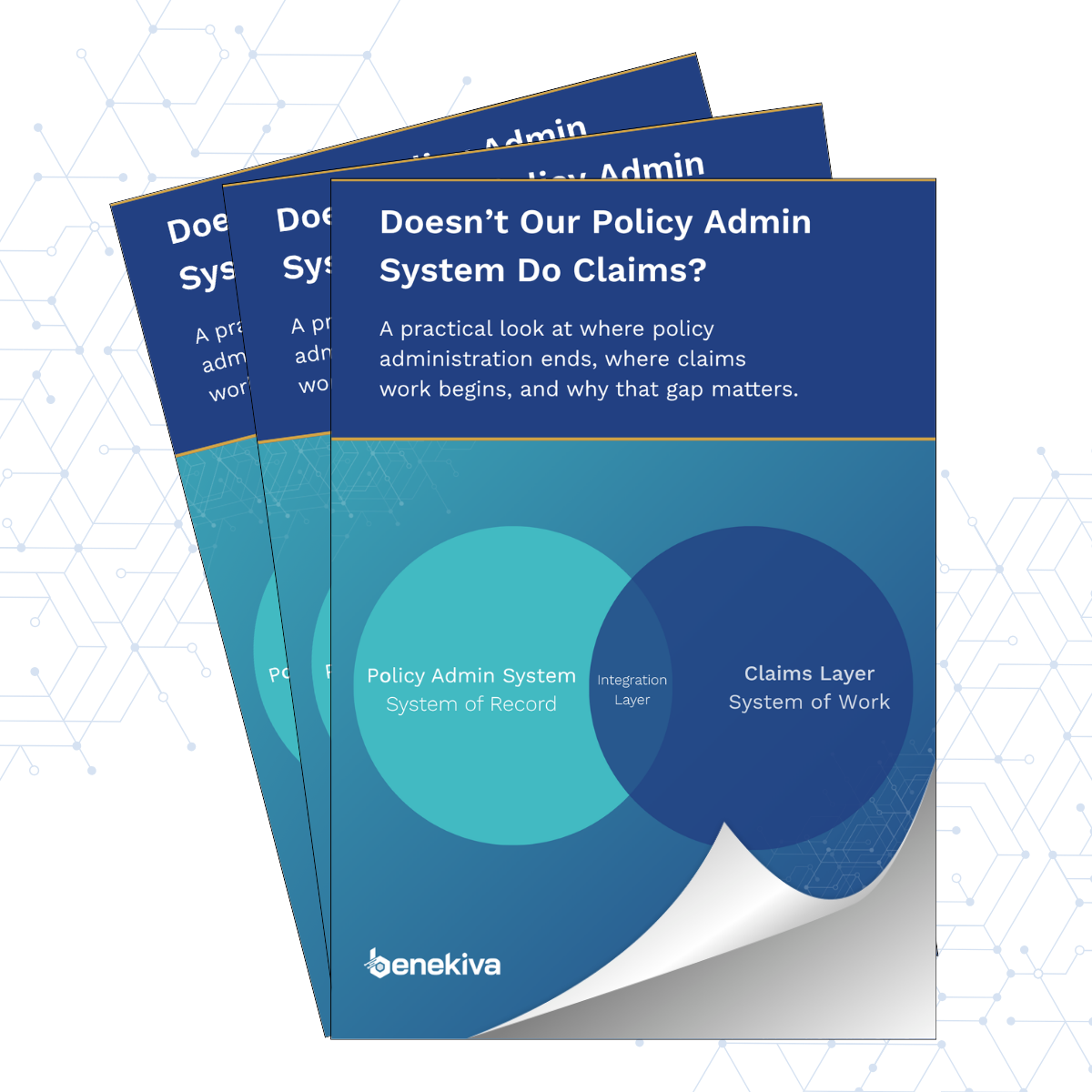
This white paper explores the difference between a PAS as the system of record and a dedicated claims layer as the system of work. It also outlines why that distinction matters for claims teams, policyholders, claimants, IT leaders, and PAS partners.
From the outside, a claim can look like a straightforward transaction. A claim is opened, documents are received, a decision is made, and a payment is issued. Inside the operation, it is rarely that simple. Claims teams often manage dozens of sub-processes across multiple systems, spreadsheets, inboxes, and manual workarounds. The PAS may hold the policy record, but the claims team still has to manage the work around that record. This creates friction in places that matter:

The hardest part of claims is often not opening the claim or recording the payment. It's everything in between: document collection, eligibility review, medical and provider coordination, benefit calculations, correspondence, approvals, and ongoing status updates.

Every missed notification, undocumented decision, manual calculation, or delayed follow-up can create risk. When compliance depends on memory, email, and individual diligence, it becomes harder to prove what happened, when it happened, and why.

Benefit calculations are not always simple. Interest, taxes, riders, offsets, cost-of-living adjustments, elimination periods, and state-specific rules can quickly move beyond what a basic claims module was designed to manage.

Claims professionals shouldn't have to log into multiple systems, rekey data, chase documents manually, or rely on tribal knowledge to do work that technology can support. The more friction the team carries, the more it shows up in speed, accuracy, morale, and claimant experience.
In most cases, the PAS should remain exactly what it was built to be: the system of record for policy data, billing, and core administration. But claims needs a system of work around it. A dedicated claims layer gives teams a place to manage the full journey from submission to close, while still connecting to the PAS for the source data that matters. When those two layers work together, carriers get a stronger operating model, claims teams get the depth they need, and claimants get a more transparent experience.

In this white paper, you'll learn:
If your team has ever asked, “Doesn’t our policy admin system already do claims?” this white paper can help clarify the better question: Does it do enough of claims to support the complexity your team manages every day?
Download the white paper to explore where the PAS ends, where claims work begins, and why the right architecture matters.